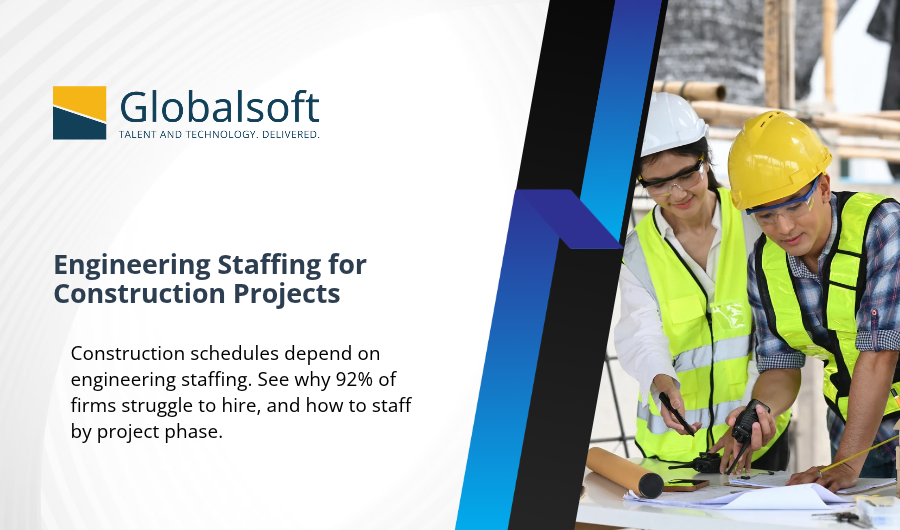
Construction projects live and die by schedule, and engineering staffing is one of the most common reasons that schedule slips. A missing structural engineer at the design phase, a gap in civil engineering support during permitting, or an unfilled site engineer role once ground breaks can each independently push a completion date back by weeks. In a sector where 92% of firms report difficulty hiring, staffing has moved from an operational detail to a genuine project risk.
The Talent Squeeze Is Structural, Not Seasonal
Construction’s labor shortage extends well beyond the trades. The industry needs an estimated 349,000 net new workers in 2026 alone, with that figure projected to climb to 456,000 in 2027 as spending accelerates, and a significant share of that demand is replacement demand from retiring supervisors and experienced engineering staff rather than pure growth. Nearly half of construction firms report having delayed projects specifically because of workforce shortages, a direct line from staffing gap to missed deadline that owners and general contractors increasingly plan around rather than hope avoids them.
Engineering roles sit at a particularly sensitive point in this shortage. Losing an experienced project engineer or structural lead doesn’t just remove labor hours, it removes jobsite judgment, design coordination knowledge, and the ability to make fast calls when conditions change mid-build. Replacing that person with someone earlier in their career is rarely a clean one-to-one swap in the near term.
Why Construction Engineering Staffing Runs on a Different Rhythm
Unlike a steady-state engineering role, construction engineering staffing follows the shape of the project itself. Design-phase engineers, structural, civil, MEP, are needed heavily upfront and less so once a project moves into active construction, while site engineers, project engineers, and construction managers ramp up sharply once ground breaks and stay essential through commissioning. A staffing plan built around a fixed headcount number, rather than the project’s actual phase-by-phase needs, routinely either overstaffs the wrong phase or leaves the right phase short.
The Roles Under the Most Pressure
Project engineers, who coordinate between design intent and field execution, are consistently among the hardest construction engineering roles to fill, because the role demands both technical fluency and the field judgment to solve problems that blueprints don’t fully anticipate.
Civil and structural engineers supporting infrastructure and large-scale commercial builds are in especially tight supply as data center, energy, and public infrastructure spending compete directly for the same specialized talent pool construction projects also need.
MEP engineers are increasingly hard to source as building systems, power, cooling, life safety, grow more complex, particularly on projects with heightened technical requirements like data centers or healthcare facilities.
Why Contract and Project-Based Staffing Fits Construction So Well
Construction staffing needs are, almost by definition, tied to a project’s lifespan rather than permanent. Hiring a full permanent engineering staff sized for a project’s peak demand creates the same problem on the back end: once that project wraps, the company is left managing excess headcount with no equivalent workload to justify it. Contract and project-based engineering staffing solves this directly, scaling capacity up during design and construction peaks and down once a project moves into a lower-intensity phase, without the cost or disruption of a layoff cycle every time one project ends and the next hasn’t started yet.
Building a Staffing Plan Around the Actual Project Pipeline
The construction firms handling this well aren’t reacting once a phase is already understaffed. They’re mapping their project pipeline several months out, identifying which phases of upcoming projects will need design engineers versus field engineers versus commissioning specialists, and building relationships with a staffing partner well before that specific need becomes urgent. Waiting until a project’s ground-breaking date to start sourcing site engineers means competing with every other contractor doing the same thing at the same time in the same regional labor market.
What This Looks Like in Practice
- Map staffing needs to project phase, not a flat headcount target. Design, construction, and commissioning each call for a different mix of engineering roles.
- Build a pre-qualified bench before a project breaks ground, rather than starting the search once the schedule is already tight.
- Use contract staffing for phase-specific peaks, reserving permanent hires for roles that carry across projects and provide ongoing institutional value.
- Treat regional labor competition as a planning input. Markets with multiple concurrent large projects, infrastructure, data centers, commercial builds, deplete the same specialized talent pool simultaneously.
The Bottom Line
Construction schedules are only as reliable as the engineering staffing behind them, and in a market with genuine, structural labor shortages, that staffing rarely takes care of itself. Firms that plan engineering capacity around the actual shape of their project pipeline, rather than scrambling once a phase is already short, are the ones hitting deadlines while competitors absorb the cost of delay.
Globalsoft Solutions helps construction firms staff engineering roles around real project timelines, from design-phase specialists to field and commissioning engineers. Our contract staffing service is built to scale with your project’s actual phase, not a fixed headcount guess. Contact us to build a staffing plan around your next construction project.
Sources
- Addressing the Construction Industry Labor Shortage: Key Strategies | ABC Carolinas
- Construction Labor Shortage 2026: ICE Raids, Retirements, 500K Jobs Gap | Construction Owners
- Engineering Market Trends: Q1 2026 Review & Outlook | Bartech Staffing