Manufacturing runs on two distinct engineering functions that rarely get staffed with the same discipline: the engineers who design and refine a product, and the engineers who make sure it can actually be built, reliably, safely, and at scale. When staffing treats these as interchangeable, the gap between them becomes the company’s problem, not the engineers’.
Why This Gap Exists in the First Place
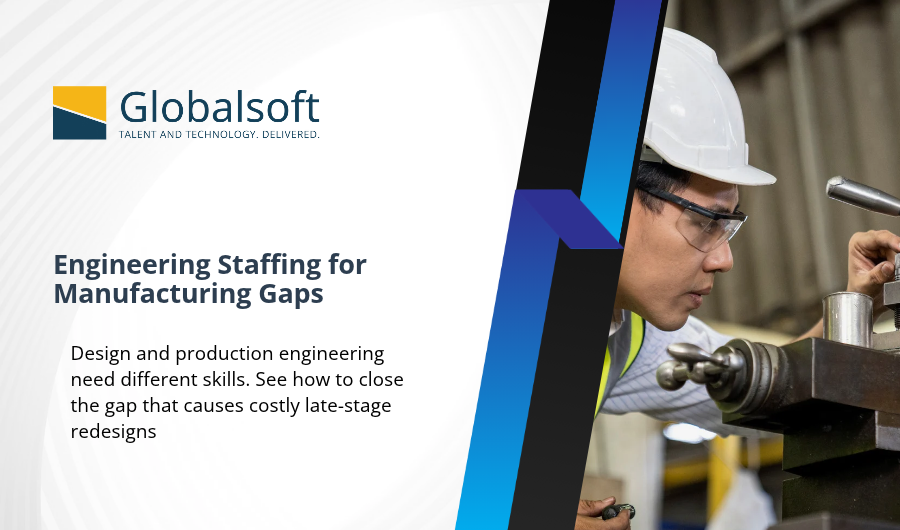
Design and product engineering teams optimize for innovation, exploring possibilities, iterating on concepts, and solving problems that don’t yet have known answers. Production and manufacturing engineering optimizes for the opposite: consistency, efficiency, and reliable execution of a defined process, day after day, within tight cost and safety constraints. A company that hires only one type of engineering capability, or staffs both functions with people evaluated against the same generic criteria, routinely ends up with products that are hard to actually manufacture, or a production line staffed by people without the design context to solve problems efficiently when something doesn’t translate smoothly from the lab to the floor.
The Handoff Is Where Most Delays Actually Happen
The friction point in manufacturing engineering staffing rarely shows up during design and rarely shows up once production is stable, it shows up in the handoff between the two. A product engineered without manufacturing constraints in mind, and evaluated only by design engineers who never considered production feasibility, frequently requires expensive redesign once it reaches the floor. Companies that staff for this handoff explicitly, either through manufacturing engineers embedded early in the design process or through a staffing partner who understands both sides of the function, close this gap before it becomes a costly late-stage discovery.
Why This Matters More as Manufacturing Technology Advances
The bar for closing this gap keeps rising. A majority of mechanical engineering firms, roughly 65%, have already integrated AI into design and manufacturing workflows, and AI-based automation, quality control, and supply chain management are actively reshaping production processes. Engineers who understand only the design side or only the traditional production side are each missing a growing portion of how modern manufacturing actually operates, and staffing that doesn’t account for this cross-functional shift produces hires who are technically capable but not fully equipped for how the work has changed.
What Strong Manufacturing Engineering Staffing Actually Requires
Distinct evaluation criteria for design versus production roles. A design engineer should be evaluated on creative problem-solving and comfort with ambiguity. A production engineer should be evaluated on process discipline and the ability to execute reliably within defined constraints. Using the same interview rubric for both roles routinely misjudges candidates on one side or the other.
Deliberate staffing for the handoff itself. Whether through a manufacturing engineering liaison role or a structured design-for-manufacturability review built into the hiring plan, someone needs to own the translation between what a product engineer designs and what a production line can actually execute.
Flexibility to scale production engineering with output demand. Production engineering needs frequently spike around a new product launch, a line expansion, or a seasonal production surge, in a way design engineering headcount typically doesn’t. Staffing plans that don’t distinguish between these two demand patterns often over-hire on one side or under-hire on the other.
Where Contract Staffing Fits This Gap Particularly Well
Bridging design and production gaps often means bringing in specific technical expertise for a defined window, a design-for-manufacturability review, a production ramp-up for a new product launch, or troubleshooting support when a product doesn’t translate cleanly to the floor. Contract engineering staffing is well suited to exactly this kind of targeted, time-bound need, providing the specific capability required without a permanent headcount commitment for a gap that, once closed, doesn’t require ongoing staffing at the same level.
What This Looks Like in Practice
- Separate hiring criteria for design and production engineering roles, rather than a single generic “manufacturing engineer” job description covering both
- Build the design-to-production handoff into the staffing plan explicitly, not as an afterthought once a product reaches the floor
- Match staffing model to demand pattern. Steady core design capability may justify direct hire, while production ramp-up around launches often fits contract staffing better
- Evaluate for modern manufacturing technology fluency on both sides, since AI and automation are increasingly part of both design and production workflows
The Bottom Line
The gap between design and production engineering isn’t a staffing inconvenience, it’s a recurring source of redesign costs, delayed launches, and production problems that trace back to a hiring process that never distinguished between two genuinely different engineering functions. Manufacturers who staff deliberately for both sides, and for the handoff between them, consistently avoid the expensive late-stage surprises that come from treating manufacturing engineering as a single, generic hire.
Globalsoft Solutions helps manufacturers staff both design and production engineering roles, matched to the distinct skills each function actually requires. Our direct hire and permanent staffing and contract staffing services are built to close the gap between what gets designed and what gets built. Contact us to talk through your next manufacturing engineering hire.
Sources
- 2026 AI, Automation, and the Future of Mechanical Engineering Degree Careers | Research.com
- Engineering Hiring & Staffing Trends for 2026 | Sigma Design