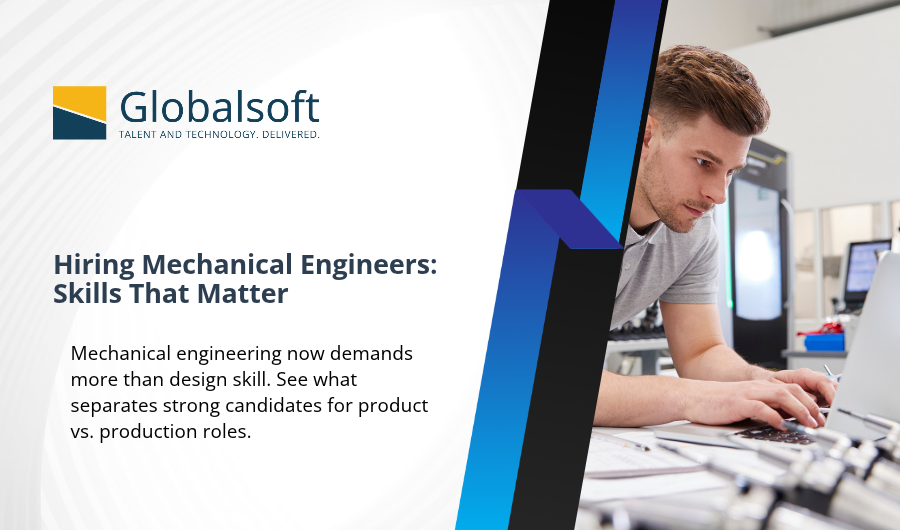
Mechanical engineering hiring has always required matching a candidate’s specialization to a specific application, but that matching has gotten more complex as the discipline itself absorbs new technical expectations. A mechanical engineer strong in traditional design and analysis may still be a partial fit if the role also demands programming fluency, simulation software expertise, or comfort working alongside AI-driven manufacturing tools that didn’t factor into hiring criteria even a few years ago.
The Skill Bar Has Genuinely Shifted
A striking 65% of mechanical engineering firms have already integrated AI to optimize workflows, reshaping what the job actually requires day to day. This isn’t a future consideration, it’s already the operating reality most mechanical engineering candidates are being evaluated against. Employers increasingly prioritize programming and coding fluency, particularly in languages like Python and MATLAB, alongside traditional mechanical design skills, since these capabilities let engineers work with AI-driven design tools and automated manufacturing processes rather than around them.
Why Manufacturing and Product Development Need Different Profiles
A mechanical engineer working in product development is solving a fundamentally different problem than one working in manufacturing engineering, even though both share the same underlying discipline. Product development calls for iterative design thinking, comfort with early-stage ambiguity, and the ability to refine a concept through multiple rounds of testing and revision. Manufacturing engineering calls for process discipline, an eye for efficiency at scale, and the ability to make a validated design actually producible within real cost, tooling, and quality constraints. A candidate strong in one of these areas isn’t automatically strong in the other, and hiring criteria that don’t distinguish between them tend to produce mismatches on one side or the other.
Industry Context Changes What “Strong” Actually Means
Mechanical engineering talent needs vary meaningfully by sector, and the leading edge of demand differs accordingly. In automotive, AI plays a growing role in design optimization, predictive maintenance, and autonomous vehicle development, meaning candidates strong in traditional mechanical design without exposure to these areas are increasingly at a disadvantage. In aerospace, advanced simulation, fault detection, and AI-assisted performance analysis are becoming standard expectations rather than specialized add-ons. In general manufacturing, AI-based automation and quality control fluency increasingly separates strong candidates from merely qualified ones.
What to Actually Evaluate
- Core mechanical design and analysis fundamentals. These haven’t gone away, and they remain the foundation every other skill builds on.
- Programming and simulation tool fluency, particularly Python, MATLAB, and CAD-integrated simulation software, which increasingly shapes how effectively an engineer can work with modern design and manufacturing tools.
- Sector-specific technical alignment. A strong automotive mechanical engineer and a strong aerospace mechanical engineer are evaluated against meaningfully different technical benchmarks, don’t default to a one-size-fits-all rubric.
- Clarity on product development versus manufacturing engineering fit. These are different jobs wearing the same job title, evaluate for the specific one you’re actually filling.
- Comfort with AI-integrated workflows, since this is no longer an advanced or optional skill in a majority of mechanical engineering environments.
Why Getting This Wrong Is Costly
A mechanical engineer hired for product development but expected to also handle manufacturing engineering responsibilities, or vice versa, often struggles not from lack of technical skill but from a genuine mismatch in what the role actually demands day to day. That mismatch shows up as slower ramp-up time, frustration on both sides, and often early turnover, all of which trace back to a hiring process that didn’t distinguish clearly enough between two related but distinct mechanical engineering functions.
The Bottom Line
Hiring mechanical engineers well in 2026 means evaluating for more than core design competence. It means confirming genuine fluency with the programming and simulation tools reshaping the field, matching candidates to the right specialization within mechanical engineering itself, and being honest about whether a role calls for product development thinking or manufacturing engineering discipline before the job description ever gets written.
Globalsoft Solutions helps manufacturers and product companies find mechanical engineers matched to the specific technical demands of their role, whether that’s product development, manufacturing engineering, or a hybrid of both. Our direct hire and permanent staffing service is built to evaluate for the right fit, not just the right degree. Contact us to talk through your next mechanical engineering hire.
Sources
- 2026 AI, Automation, and the Future of Mechanical Engineering Degree Careers | Research.com
- Engineering Hiring & Staffing Trends for 2026 | Sigma Design