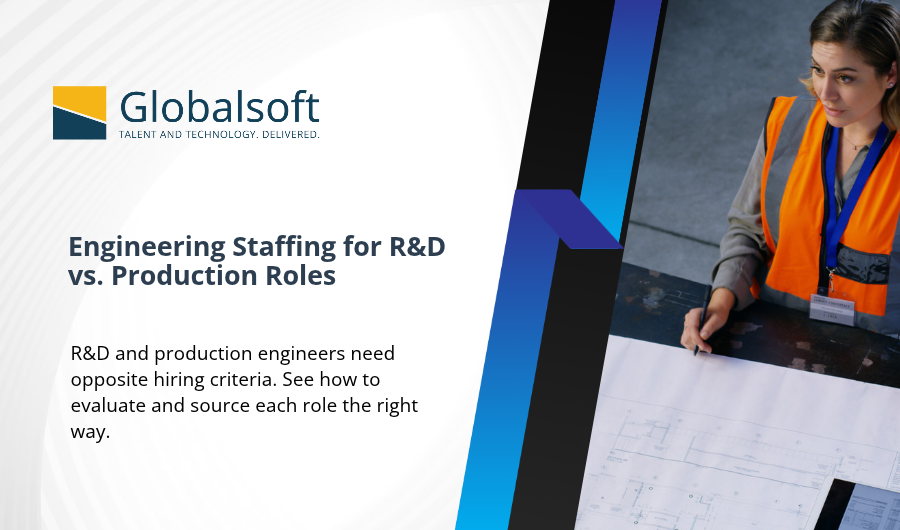
A job posting titled “Engineer” tells you almost nothing about what a company actually needs. An R&D engineer and a production engineer might share a degree and a job family, but the work, the skills that matter most, and the kind of person who thrives in each role are genuinely different. Treating both hires with the same job description and evaluation process is one of the quieter reasons engineering searches produce a technically qualified candidate who still isn’t the right fit.
R&D Engineering: Innovation Under Genuine Uncertainty
R&D engineers work as innovation architects, combining scientific expertise with creative problem-solving to design and refine products, processes, and technologies before they’re ready to scale. This work is inherently exploratory. R&D engineers design experiments, build prototypes, and iterate quickly to test what’s possible, often without a clear roadmap for how to get there or certainty that the approach will even work.
That uncertainty shapes what makes someone genuinely strong in this role. Comfort with ambiguity, creative problem-solving, and the ability to iterate through failure matter as much as raw technical credentials. A handful of skill clusters are shaping R&D hiring specifically right now: research and data analysis, hands-on product development, CAD-driven engineering work, and regulatory and quality compliance knowledge, particularly in biotech, healthcare, and advanced manufacturing, where R&D output has to eventually clear a regulatory bar, not just work in a lab.
Production Engineering: Precision Under Defined Constraints
Production engineering runs on a fundamentally different logic. Where R&D optimizes for exploration, production optimizes for consistency, efficiency, and reliability at scale. A production engineer isn’t asking “could this work,” they’re ensuring a known process runs correctly, safely, and efficiently, day after day, often within tight cost and timeline constraints that leave little room for open-ended experimentation.
This distinction shows up clearly in what the broader engineering market is currently rewarding. With engineering demand strong and manufacturing employment declining, employers are increasingly favoring versatility and near-term ROI in new hires, people who can step into a defined operational need and deliver measurable impact quickly, rather than candidates hired primarily for long-term potential. That’s a meaningfully different hiring bar than R&D, where potential and exploratory capability are often exactly what you’re paying for.
Why Hiring for Both the Same Way Backfires
The market itself has shifted in a way that makes this distinction more consequential than it used to be. Demand has moved decisively away from broad technical knowledge toward deep, applied expertise, employers are no longer hiring engineers primarily for potential, they’re hiring for immediate impact. That shift cuts differently across R&D and production. An R&D candidate who can’t tolerate ambiguity will struggle regardless of technical polish, because the role’s entire value is in figuring out what doesn’t yet have a known answer. A production candidate hired mainly for creative potential, without a track record of executing reliably within defined constraints, often struggles just as much, for the opposite reason.
What to Actually Evaluate for Each
For R&D roles:
- Evidence of genuine exploratory work, prototypes, experiments, documented iteration through failure, not just completed, polished projects
- Comfort articulating what they don’t yet know, rather than overselling certainty in early-stage work
- Cross-disciplinary fluency, since R&D increasingly sits at the intersection of traditional engineering and adjacent skills like data analysis, machine learning integration, or regulatory science depending on the industry
- A structured interview process combining technical assessment with portfolio review, since a resume alone rarely captures exploratory capability well
For production roles:
- A track record of delivering measurable, near-term operational impact, not just technical breadth
- Demonstrated ability to work reliably within safety, quality, and cost constraints
- Process discipline and consistency under repeated, similar conditions, the opposite skill set from R&D’s comfort with ambiguity
- Direct experience with the specific production environment, since a mismatch in manufacturing environment or process methodology can derail an otherwise strong technical hire
Why This Distinction Should Shape Your Sourcing Strategy Too
Even where you look for candidates should reflect this split. R&D hiring increasingly pulls from research-adjacent backgrounds, publications, open-source contributions, internships at labs, and roles with genuine research components, while production hiring benefits more from candidates with direct operational experience in similar manufacturing or process environments. A staffing partner or internal recruiter sourcing both types of roles through the same channel, using the same job description template, is likely under-serving one side of the split.
Onboarding Also Looks Different
The two roles don’t just need different hiring criteria, they benefit from different onboarding approaches too. R&D hires often need time and structured mentorship to get oriented in an ambiguous, exploratory environment, while production hires benefit from fast, structured onboarding tied directly to specific processes and safety protocols they need to execute correctly from day one. Structured onboarding overall meaningfully improves new hire retention, but what “structured” actually means looks different depending on which kind of engineering role you’re bringing someone into.
The Bottom Line
R&D and production engineering aren’t variations on the same hiring problem, they’re built around opposite core competencies: comfort with uncertainty versus precision within known constraints. Companies that write a single generic “Engineer” job description and apply it to both are setting themselves up for a mismatch, however strong the individual candidate looks on paper. Defining which kind of engineering capability a role actually requires, before the search begins, is the clearest way to avoid that gap.
Globalsoft Solutions helps companies hire for both sides of this divide, sourcing R&D talent built for exploration and production talent built for reliable execution, matched to what each specific role actually demands. Our direct hire and permanent staffing and contract staffing services are built to source the right profile for each. Contact us to talk through your next R&D or production engineering hire.
Sources
- How to Master R&D Engineering Recruitment: Expert Guide for 2026 | Talent Business Partners
- Engineering Hiring & Staffing Trends for 2026 | Sigma Design
- The 2026 Engineering Hiring Market: Salary Trends, Skills & Recruiting Insights | DAVRON