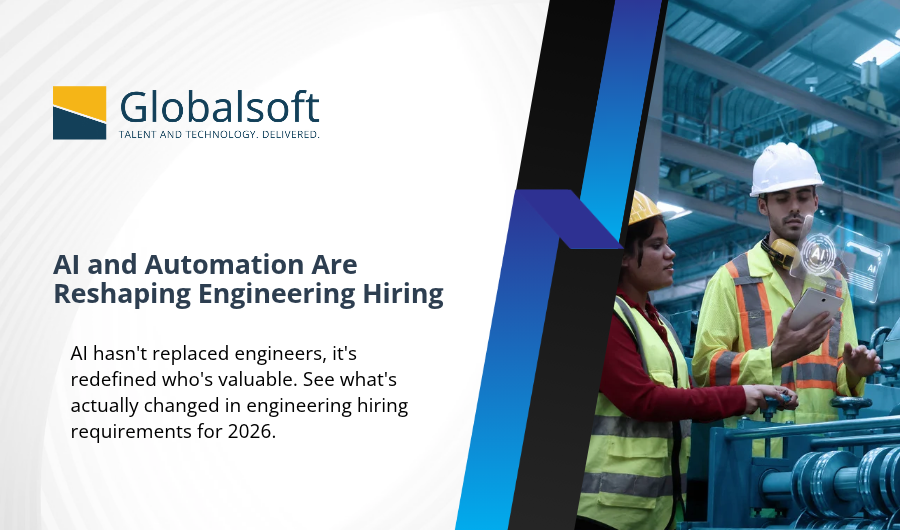
The job description that worked for an engineering hire two years ago is quietly out of date. Not because the core discipline changed, mechanical engineering is still mechanical engineering, but because what separates a strong candidate from an average one has shifted. AI isn’t replacing engineers. It’s changing what makes an engineer valuable, and companies still hiring against the old skill checklist are increasingly screening out the candidates who’d actually perform best.
Technical Expertise Alone Is No Longer the Differentiator
Across engineering disciplines, employers increasingly need people who can effectively leverage AI-assisted tools as part of their core workflow, not as an optional add-on skill listed at the bottom of a resume. This shows up concretely in mechanical engineering, where a striking 65% of firms have already integrated AI to optimize workflows, reshaping what the job actually requires day to day. A candidate with strong traditional mechanical design skills but no exposure to AI-driven design tools is increasingly competing at a real disadvantage, regardless of how solid their fundamentals are.
The Routine Work Is Exactly What’s Disappearing
AI’s impact isn’t evenly distributed across engineering tasks. Engineers whose primary value proposition is repetitive, routine implementation work face the most pressure, because that’s precisely where AI tools now excel. This doesn’t mean those functions vanish, it means the humans doing them need to move up the value chain, toward system design, validation, and judgment calls AI tools can’t make on their own. Job postings that still emphasize routine execution skills as the primary qualification are hiring for a version of the role that’s shrinking.
Compensation Data Confirms the Shift Is Real, Not Hype
This isn’t just a talking point in hiring articles, it shows up directly in pay. Postings that explicitly require AI-related skills command a documented compensation premium over postings in the same function and seniority level that don’t, and salaries for roles involving AI capability have risen 10% to 15% faster than roles without them over the past several years. Employers who aren’t factoring this into their compensation strategy risk losing exactly the candidates most capable of adapting to where the role is heading.
What “AI-Ready” Actually Means Varies by Discipline
The specific skills employers should screen for aren’t identical across engineering fields. In software and systems engineering, that increasingly means fluency with AI-assisted development tools and the ability to build end-to-end applications incorporating AI features. In mechanical and industrial engineering, it means programming and simulation skills, particularly in languages like Python, that let engineers work with AI-driven design and predictive maintenance tools. In manufacturing-adjacent roles, it means comfort with AI-based automation, quality control systems, and supply chain optimization tools that are reshaping the production floor itself.
Don’t Confuse “Uses AI Tools” With “Builds AI Systems”
One of the more common hiring mistakes right now is writing a job description that blurs a meaningful distinction: using AI tools to work faster is a different skill than designing or orchestrating AI systems themselves. Job descriptions should clearly distinguish between roles that expect AI-assisted work and roles that expect the candidate to actually design or integrate AI systems, so candidates self-select accurately and hiring managers evaluate against the right bar. A mismatch here produces exactly the kind of hire who looks qualified on paper but can’t deliver what the role actually needs.
AI Skills Are Also Genuinely Hard to Evaluate in an Interview
A resume listing “prompt engineering” or “AI tools” doesn’t tell you much on its own, many employers are discovering that these skills are difficult to assess through a standard technical interview. The stronger signal increasingly comes from what a candidate has actually built, delivered projects, working repositories, and evidence of real deployment, rather than credentials or a list of tool names. Hiring processes still relying primarily on resume screening and theoretical technical questions are missing this shift.
Sourcing Channels Have Shifted Too
The strongest AI-fluent engineering candidates increasingly surface outside traditional job boards, in open-source project contributions, technical communities, and documented portfolios of real, deployed work. A recruiting process built entirely around job board postings and resume keyword matching is fishing in an increasingly shallow pool for exactly the candidates most companies are competing hardest to land.
What This Means for Retention, Not Just Hiring
This shift doesn’t stop mattering once someone’s hired. Engineers who feel like they’re being automated away, rather than equipped to do higher-impact work, are a real retention risk. Companies that pair AI-informed hiring with clear career paths tied to AI integration, architecture, and technical leadership, not just lines of code written, are better positioned to keep the engineers this hiring shift is designed to attract in the first place.
What to Actually Change in Your Hiring Process
- Rewrite job descriptions to distinguish AI-assisted work from AI systems work, so the role attracts the right candidate pool
- Evaluate based on delivered work, not just resume keywords or credentials, since AI fluency is hard to verify through conversation alone
- Adjust compensation benchmarks to reflect the real premium AI-capable candidates now command
- Widen sourcing beyond traditional job boards, toward open-source contributions and technical communities where AI-fluent engineers are more visible
- Build the retention conversation into the hiring plan, since attracting AI-capable engineers only pays off if they stay
The Bottom Line
AI hasn’t replaced engineers, but it has meaningfully redefined which engineers are most valuable and how to actually identify them. Companies still hiring against a pre-AI job description are competing for a shrinking slice of the market while losing out on the candidates increasingly commanding a real compensation premium elsewhere. Updating the hiring bar, not just the job title, is what keeps a company competitive for this talent going forward.
Globalsoft Solutions helps engineering teams identify candidates who bring real AI fluency alongside strong technical fundamentals, evaluated against what the role actually requires today. Our direct hire and permanent staffing service is built to source for where engineering hiring is actually heading. Contact us to talk through updating your next engineering search.
Sources
- Engineering Talent in 2026: What’s Changed and Why Your Hiring Approach Must Too | Corps Team
- The Future of Software Engineering Jobs in 2026: What Hiring Managers Need to Know | Second Talent
- 2026 AI, Automation, and the Future of Mechanical Engineering Degree Careers | Research.com
- Hiring Trends 2026: What Engineering Leaders Need to Know | DAVRON